Property Highlights
- Bonanza Mountain covers the historical Knight’s Camp, a scene of significant exploration and development activity over a short period from the late 1800s through to the early 1900s.
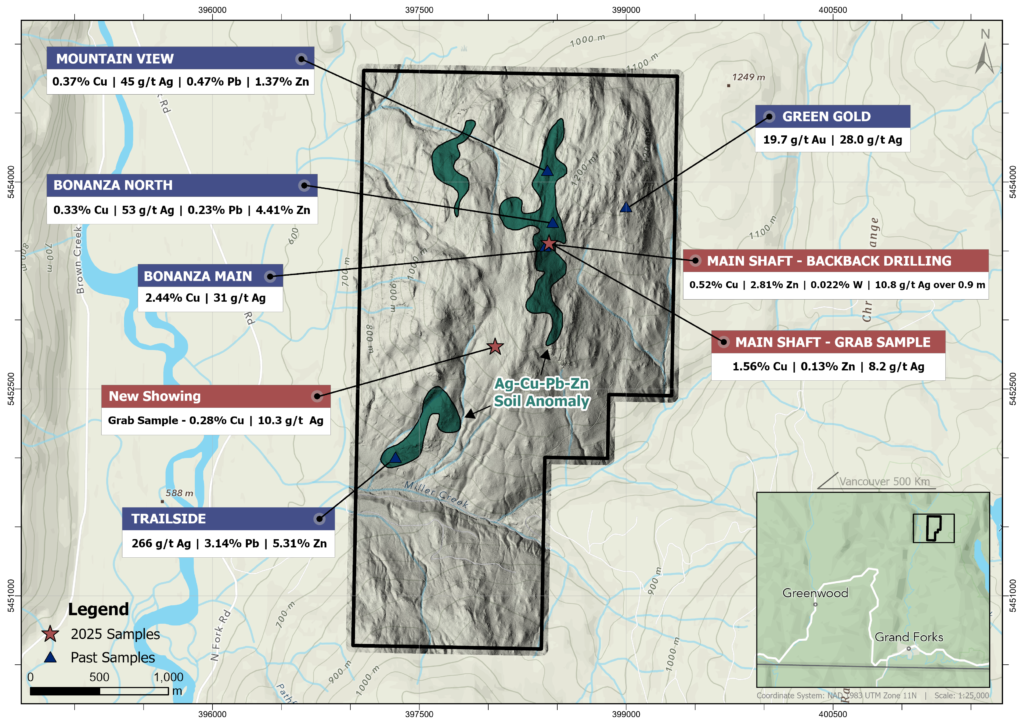
- Exploration work by the Company in 2018/2019 rediscovered underground and surface workings unexplored since the early 1900s and outlined a >1 km long polymetallic soil anomaly associated with these workings
- Highlighted grab samples1 include 2.44% Cu, 31 g/t Ag from the Main Shaft, 266 g/t Ag, 3.14% Pb and 5.31% Zn from the Cataclasite showing, and 19.7 g/t Au, 28 g/t Ag from the Winze showing.
The Bonanza Mountain property consists of three claims totalling 802 ha., is readily road-accessible, and is situated approximately 20 km due north of Grand Forks, B.C., on the east slope of the Granby River. The project encompasses the historic Knight’s Camp, centered on the Bonanza, Mountain View, Colorado and Nevada lapsed Crown grants on what is locally known as Bonanza Mountain. The project is prospective for Cu-Zn-Ag-W skarn and Au-Ag epithermal mineralization.
Bonanza Mountain was the scene of significant exploration and development activity over a short period from the late 1800s through to the early 1900s. Historic details of the activities have been sourced from local newspapers from the period, original Crown grant documents, Annual Reports to the Minister of Mines, and the online GATOR system (a database registry of Crown land records for British Columbia).
The first mention of high-grade gold at Bonanza Mountain was reported on July 20, 1896 by the Spokane Chronicle. The development of a 50 foot shaft centered on the discovery followed with the Grand Forks Miner reporting on January 16, 1897 that the owners, “are now working on the Bonanza property in Knight’s Camp. The [recovered material] increasing in value as they sink.”
This was not the only discovery. The Midway Advance reported on April 26, 1897 that, “…numerous veins of iron and copper sulphide outcrop [on the Bonanza group of claims], from a few feet to ten feet in width…” and returned high grade gold and copper in assay*.
By 1901, multiple shafts and tunnels were developed on the Bonanza Crown Grants with associated drifting and open cuts (Annual Report to the Minister of Mines). No further work was reported on the Bonanza Crown Grants after 1901 and the abrupt absence from the historical record remains unexplained.
Field work completed from 2019 – 2025 included extensive mapping, prospecting, soil sampling, backpack drilling at the Main Shaft and a property wide LiDAR survey.
Two backpack drill holes were completed at the Main Shaft. The first hole collared into chlorite-epidote skarn with malachite on fracture planes near surface. This interval returned 0.52% Cu, 2.81% Zn, 0.022% W and 10.82 g/t Ag over 0.9 m. The second hole was collared approximately 0.5 m east, also encountering chlorite-epidote skarn, but with no visible copper staining. Hole 2 assayed 0.59% Cu, 2.77% Zn, and 6.4 g/t Ag over 0.65 m.
Geochemical soil sampling has delineated a greater-than-one-kilometre-long-by-150-metre-wide north-south coincident Cu-Ag-Pb-Zn soil anomaly that follows a significant topographic feature and is open to the north along this same feature. Most historic workings are within or adjacent to this multielement soil anomaly.